Forty-Five Millimetre Tyres: What the Gravel Bike Is Built For
A gravel bike is a road bike that gave up speed for surface. The Scott Addict Gravel RC on brandmybicycle shows it in every tube: wider tyres, a taller head tube, a down tube built to take stones. This post reads the bike's design as a description of its roads, and of what a logo on it is in for.
The gravel bike on brandmybicycle is a Scott Addict Gravel RC: Addict Gravel HMX carbon, SRAM RED XPLR AXS, Fulcrum Sharq carbon wheels and 45 mm tyres, size M, listed by Scott in Germany at the price that becomes the board’s goal. Every one of those choices is a statement about where the bike goes. This post reads the bike’s design as a map of its roads, and as a description of what a sponsor’s mark will live through.
Forty-five millimetres
A road tyre is 25 to 28 mm wide. Forty-five is nearly double, and the difference is the difference between tarmac and everything else: gravel, fire roads, forest tracks, washboard, the village roads the post on where the gravel bike goes describes. A wide tyre runs at low pressure, absorbs stones and finds grip on loose climbs. For a sponsor the width has a second consequence: a 45 mm tyre has a sidewall you can print on, which is why the gravel board has two tyre wall zones at 20 by 3.5 centimetres and the road board has none.
A down tube built for stones
The site says it plainly: a gravel down tube is built fat to survive stone strikes. On this bike that makes it the largest flat panel, 18 by 8 centimetres, a centimetre bigger each way than the road bike’s. The lower half is the one the front wheel throws dirt at, and the vinyl there is laminated so it comes back clean at every wash. The post on the down tube is written about the road bike; on the gravel bike the same zone is larger, cheaper in dollars and takes more punishment.
Long chain stays
Gravel chain stays run 425 mm, longer than a road bike’s, for stability on loose ground, and they carry a protector plate against chain slap. The result for the board is an 18 by 3.5 centimetre chain stay panel against the road bike’s 16 by 3, lower down and closer to the surface. It is the panel in every low-angle photograph of the bike on a track, and it is sold at $374.
A taller head tube and a flared bar
A gravel frame sits higher at the front for control, so the head tube is taller and the badge panel is 8 by 6 rather than 8 by 5. The bar is 42 cm across the tops and 49 at the drops, and the flare turns the bar panel outward, straight at the camera, which is why the gravel handlebar panel is 16 centimetres wide against the road bike’s 12. The post on the head tube covers the badge position on both bikes.
A fork with a cargo mount
A bikepacking fork carries a three-bolt plate on each leg for cages and bags. No road fork has one. On the board that plate is the fork cargo mount zone, 11 by 5 centimetres at $326, and it is the clearest sign of what the bike is for: multi-day rides with luggage, hours from a city, which is also where the gravel film was shot. The post on the gravel bike zone by zone lists it among the three gravel-only zones.
Shallower rims, same idea
The Fulcrum Sharq rims are 42 mm deep against the road bike’s 60, deep enough to carry a full band but a centimetre shallower, so each rim panel is 24 by 4 rather than 24 by 5. A rim turns the same number of times per kilometre on either bike; the post on rims as a zone explains what that does to a mark. On gravel the wheel is also the part that gets dirtiest, and the rear rim is the panel the rider behind on a fire road watches for hours through the dust.
What a mark survives out there
Mud, water, stone strikes, washing. The site’s answer is the material: laminated vinyl on the frame, hot-patched prints on the tyre walls, both chosen because the gravel bike is washed after most rides and the mark has to come back from every wash. The post on what forever means for a vinyl logo covers the life of the wrap; on the gravel bike that life is harder and the material is specified for it.
Reading the spec sheet as a sponsor
The bike page links to Scott’s own product page, and the spec sheet there is public: Addict Gravel HMX carbon, SRAM RED XPLR AXS, Fulcrum Sharq wheels, 45 mm tyres, size M. A sponsor does not need to know what each part does to read what the list means: a top groupset and carbon wheels say the bike is ridden hard and far, the tyre width says where, and the frame material says it is light enough to be climbed with all day. The site’s line is that none of this is its word for it; the spec sheet is the maker’s, and the zones are cut from the surfaces it describes.
Who the gravel bike’s design suits
A brand that sells to people who ride away from roads: bikepacking, cycling tourism, outdoor equipment, a guesthouse at the top of a pass. The bike’s design puts its logos in front of that audience and nobody else, because, as the site says of the night film, out there the logo is the only advert on the road. The post on two bikes, two boards compares the two audiences; the tyres are the shortest way to tell them apart.
The short version
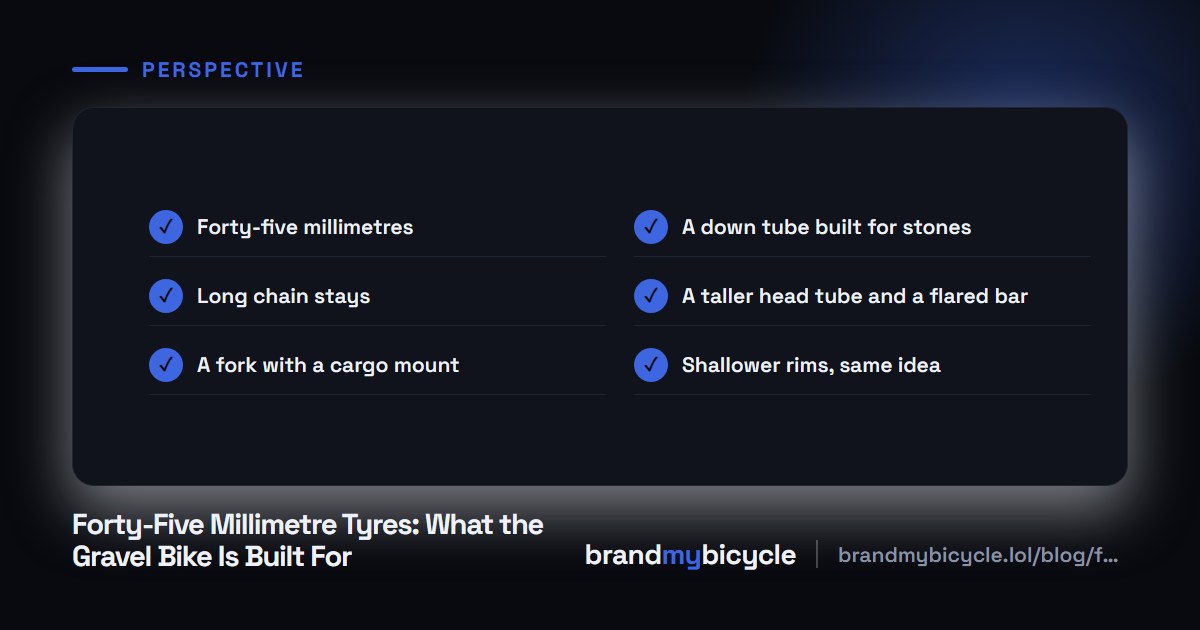
Forty-five millimetre tyres, a fat down tube, long chain stays, a tall head tube, a flared bar and a cargo fork: every choice says the bike goes where tarmac ends. Those choices create three zones the road bike lacks, make the down tube and chain stay larger, and are the reason the wrap is laminated and the tyre prints hot-patched.
Questions
What tyres does the gravel bike run?
45 mm tyres on Fulcrum Sharq carbon wheels with 42 mm deep rims, per the spec on the bike page.
Why does tyre width matter to a sponsor?
A 45 mm tyre has a sidewall wide enough to print on, which gives the gravel bike two tyre wall zones the road bike does not have.
Does mud damage the logos?
The vinyl is laminated and comes back clean at every wash, the site says of the lower down tube. The tyre walls are hot-patched to survive the mud they make.
Why is the gravel head tube taller?
A gravel frame sits higher at the front for control on rough ground. The head tube panel is a centimetre deeper as a result.
Is the gravel bike slower?
On tarmac, yes. It is built for surfaces where the road bike cannot go at all.